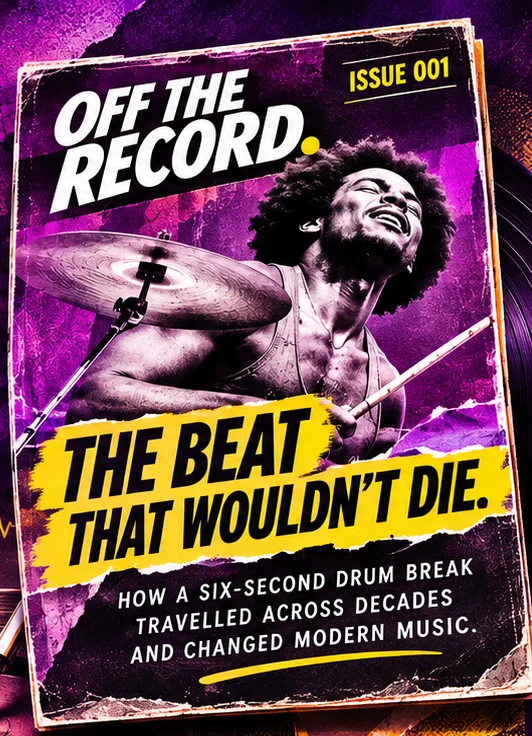
THE BEAT THAT
WOULDN'T DIE.
How a few seconds of drumming on a forgotten B-side became one of the most influential sounds in modern music.
SIX SECONDS THAT CHANGED EVERYTHING
In 1969, a drummer named Gregory C. Coleman recorded a short solo with an American soul group called The Winstons. He played four bars. The band came back in. The song continued.
Nobody stopped the session to announce that music history had just been made. Yet those few seconds would eventually find their way into hip-hop, jungle, drum and bass, pop and countless other recordings. Producers would slow them down, speed them up, cut them apart and rearrange them into rhythms Coleman had never played.
The sound would become famous. Its creator would remain comparatively unknown. This is the story of the Amen Break: a remarkable piece of drumming, an unexpected technological revolution and a complicated musical inheritance. It begins on the other side of a hit record.
THE B-SIDE NOBODY EXPECTED
In 1969, The Winstons had good reason to celebrate. Their single “Color Him Father” was a success in the United States. Its tribute to a stepfather resonated with audiences. Its songwriter, Richard Lewis Spencer, went on to win the 1970 Grammy Award for Best Rhythm & Blues Song.
But the record needed a B-side. In the era of seven-inch vinyl singles, the A-side was generally the song promoted to radio stations and record buyers. The B-side was its companion on the reverse.
The band recorded an instrumental loosely inspired by the gospel song “Amen.” A brief drum break helped extend the arrangement. Accounts differ about who proposed the solo: Spencer recalled directing the passage, while fellow band member Phil Tolotta described it as Coleman’s own idea. What is certain is that Gregory C. Coleman played those four bars. The instrumental became “Amen, Brother.” The A-side was the hit. The B-side was largely overlooked. For years, that seemed to be the end of the story.
LISTEN TO THE DRUMMER
Play “Amen, Brother” and listen from approximately 1 minute and 26 seconds. The other instruments fall silent. Gregory C. Coleman takes over.
His kick drum drives the rhythm forward. The snare strikes with authority, while the cymbals add movement and texture. Listen especially to the second half of the third bar, where the snare accents move away from the pattern your ear has begun to expect.
This is syncopation: rhythmic accents that challenge an expected beat. You do not need music theory to hear its effect. Try tapping along, then notice the small surprise in that third bar.
The passage is commonly described as about six seconds long. Just as importantly, the drums are exposed, without a vocal or melody competing for attention. That would make the passage especially useful to future producers.
WHEN RECORDS BECAME INSTRUMENTS
During the 1970s, DJs in New York were changing the relationship between recorded music and live performance. At Bronx parties, instrumental breaks became prized moments. Dancers responded to the drums, and DJs found ways to extend those passages.
DJ Kool Herc was among the pioneers associated with this approach, using two copies of a record to keep a rhythmic section going. A record no longer had to be played from beginning to end. A DJ could select an exciting moment and make it the centre of the performance.
The Amen Break did not create hip-hop, and Kool Herc is not known as its original discoverer. But break-focused DJ culture helped establish the conditions for an old drum passage to find new listeners.
By the 1980s, electronic samplers let producers capture a short passage and trigger it again. A drum solo from an older record could become the rhythm of a new song.
A SECOND LIFE IN HIP-HOP
The influential compilation series “Ultimate Breaks & Beats” included “Amen, Brother” in 1986, helping make the recording accessible to DJs and producers.
Salt-N-Pepa used the break in “I Desire” in 1986. Mantronix explored its rhythmic possibilities in “King of the Beats” in 1988. That same year, N.W.A used it in “Straight Outta Compton.”
These songs sound very different, yet all connect back to the same performance. A sample carries its own history but acquires new meaning in another musical setting. Coleman's drums had stopped being merely a passage in a song. They had become musical material.
BRITAIN TURNS UP THE TEMPO
In the early 1990s, Britain's underground dance scene was evolving rapidly. Rave culture brought together electronic styles, powerful sound systems and audiences hungry for new experiences.
Jamaican musical traditions had also profoundly influenced British popular culture through reggae, dub, dancehall and Black British sound-system communities. These influences helped shape jungle.
Producers combined deep basslines with fast, intricately manipulated breakbeats. The Amen Break was particularly suited to the approach. Individual drum hits could be separated, repeated and repositioned.
Imagine cutting a photograph into pieces and constructing a different image from the fragments. Jungle producers did something similar with sound. The result could feel unmistakably futuristic.
THE RHYTHM BECOMES AN INSTRUMENT
There is a difference between repeating a sample and reconstructing it. Loop Coleman's solo and you hear the same sequence again. Isolate the kick, snare and cymbal sounds, and you can arrange them into an entirely different pattern.
Early jungle producers explored these possibilities with samplers and sequencers. Some pushed drums towards rapid-fire arrangements; others placed them beneath atmospheric melodies and deep basslines.
The Amen Break was not the only rhythm involved. The Think Break, Apache Break and many other recordings contributed to jungle and drum and bass. Nor was jungle simply hip-hop played faster. It grew from its own cultural environment.
Artists including 4hero, Remarc, Shy FX and Goldie helped develop different sides of the sound. What united many of their recordings was the idea that a drum break could become the main event.
BEYOND THE UNDERGROUND
As jungle developed into drum and bass and related styles, breakbeat manipulation became increasingly sophisticated. Fast percussion could support spacious, emotional arrangements as readily as the intensity of a rave.
Goldie's 1995 album “Timeless” helped demonstrate the expressive possibilities of drum and bass to a wider audience.
The Amen Break travelled further still. David Bowie used it in “Little Wonder,” released in 1997. Oasis also incorporated it into “D'You Know What I Mean?” that year. A drum solo from a 1969 soul B-side was now appearing in internationally successful rock and pop recordings.
THE PEOPLE BEHIND THE SOUND
Gregory C. Coleman performed the original break. Richard Lewis Spencer helped create “Amen, Brother” and held rights associated with the composition. Yet neither received sampling royalties from the recording's widespread reuse.
Spencer later spoke publicly about his frustration. The legal and commercial environment surrounding sampling changed considerably after the 1980s, and the Amen Break's early afterlife unfolded while those practices were still developing.
Coleman experienced serious personal and financial hardship later in life. He died in Atlanta in 2006. The enormous influence of his drumming stands in painful contrast to the recognition he received during his lifetime.
A THANK-YOU, DECADES LATER
In 2015, British DJs and music supporters organised a crowdfunding campaign for Richard Lewis Spencer. Contributions arrived from people who understood what the Amen Break had meant to the music they loved.
Spencer received approximately £24,000. It was a voluntary gesture, not a legal royalty settlement. It could not compensate Coleman, who had died nine years earlier.
Nevertheless, the campaign acknowledged something important: behind a familiar sound are people whose contributions deserve to be remembered.
WHO OWNS THE FUTURE OF A SOUND?
The Amen Break raises a question that remains relevant today. When an artist transforms an existing recording into something new, how should the original creator be recognised?
Coleman's drumming was an original performance. Producers who sampled it often contributed substantial creativity through editing, arrangement and production. Both things can be true.
New digital tools, including generative AI, raise further debates about creative ownership and fair compensation. The technologies and legal questions differ, but an underlying concern remains: how do we celebrate innovation without overlooking the people whose work helped make it possible?
THE BEAT LIVES ON
Go back to the original recording. Wait for the instruments to fall away. For a few seconds, Gregory C. Coleman is simply playing drums.
He could not know that producers would one day treat his solo as an instrument in its own right, or that people would still discuss it more than half a century later.
A performance can travel beyond its creator's intentions and become part of another generation's culture. If we listen carefully, we can follow that journey back to its beginning.
Six seconds. One drummer. Countless new possibilities.
The beat never really died. It just kept finding somewhere new to live.